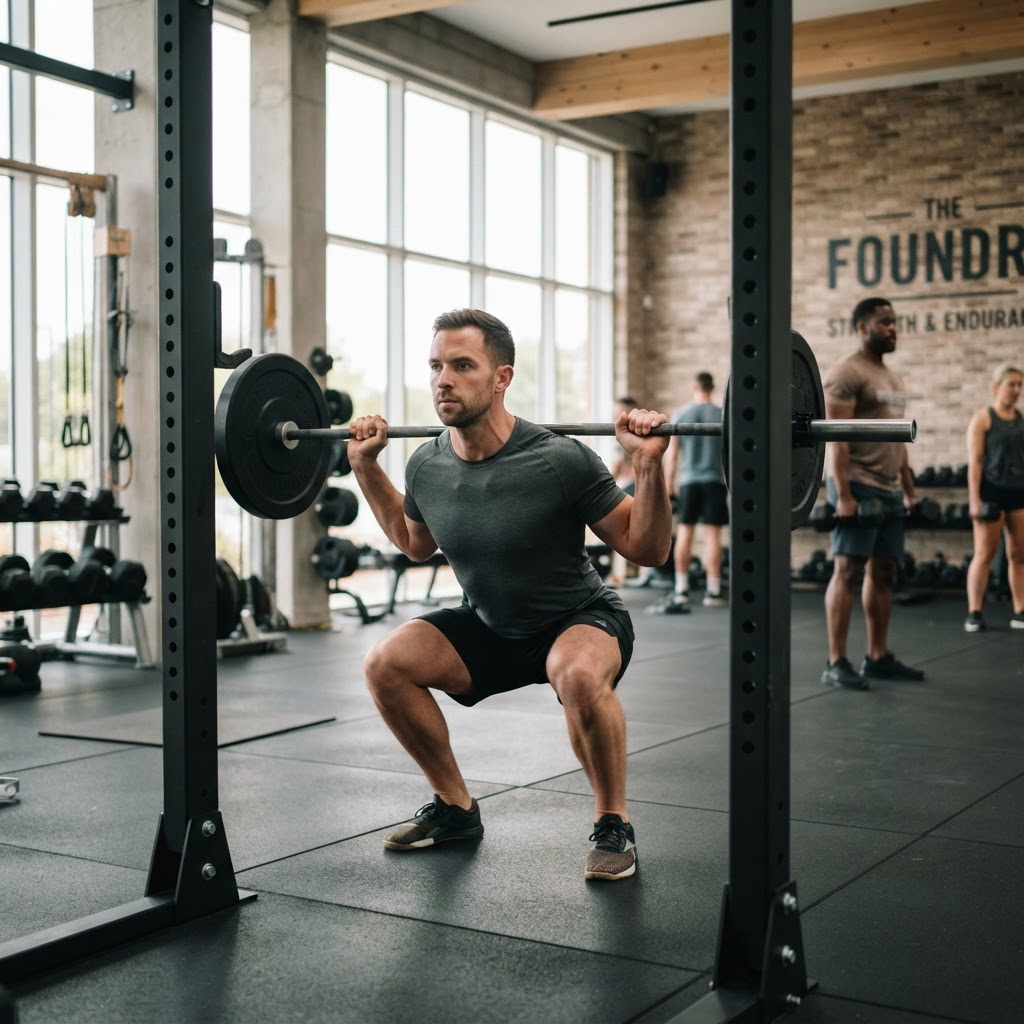
The Hidden Half of Your Lift
At Clarence Park Health Suite, we often see members focused entirely on the 'up' phase of a movement—the concentric contraction. Whether you are pushing a heavy barbell or pulling a cable, the focus is usually on getting the weight from point A to point B. However, recent scientific research suggests that the 'down' phase—the eccentric portion—is a vastly underutilized tool for building serious strength and muscle mass.
What is Eccentric Training?
Eccentric training involves emphasizing the lengthening phase of a muscle contraction. Think of the lowering phase of a bench press or the descent into a squat. While traditional training treats this as a passive return to the start, research published in the Journal of Functional Morphology and Kinesiology (2026) highlights that eccentric-focused training can provide distinct advantages for maximal strength without compromising hypertrophy [3].
Why It Works
When you lower a weight under control, you are capable of handling higher loads than you can lift concentrically. This increased mechanical tension is a potent stimulus for your muscles. Studies have shown that eccentric training at higher intensities is particularly effective at promoting increases in muscle girth and cross-sectional area [7]. By slowing down the lowering phase—often referred to as 'tempo-controlled training'—you increase the time under tension, which forces your muscle fibers to adapt to higher levels of stress.
Practical Application for Your Gym Routine
You don't need fancy equipment to start reaping these benefits. Here is how you can integrate eccentric focus into your next session at our gym:
- The 3-Second Rule: For your primary lifts (squats, presses, rows), aim for a 3-second count on the way down. Do not let gravity do the work for you; fight the weight all the way to the bottom.
- Pause at the Bottom: By pausing for one second at the bottom of the movement, you eliminate the 'stretch reflex' (the bounce), forcing your muscles to initiate the next repetition from a dead stop. This builds incredible starting strength.
- Controlled Descents: If you are working with one of our personal trainers, ask them to help you with 'accentuated eccentric loading.' This involves using a slightly heavier weight that you can lower with control, while the trainer assists you on the concentric (lifting) phase.
Consistency Over Complexity
While advanced systems like rest-pause or drop sets have their place, the most consistent driver of hypertrophy remains total volume load [10]. Eccentric training is not about making your workout more complicated; it is about making your existing sets more effective. Whether you are here for a quick solo session or working through a 1-to-1 personal training plan, adding a deliberate tempo to your movements is a simple, actionable way to ensure you are getting the most out of every repetition.
Remember, your muscles don't know how much weight is on the bar; they only know the tension they are under. By mastering the eccentric phase, you are essentially doubling the effectiveness of every single rep you perform. If you are unsure about your form or want to learn how to safely incorporate heavier eccentric loads, our team is always on hand to help you refine your technique.