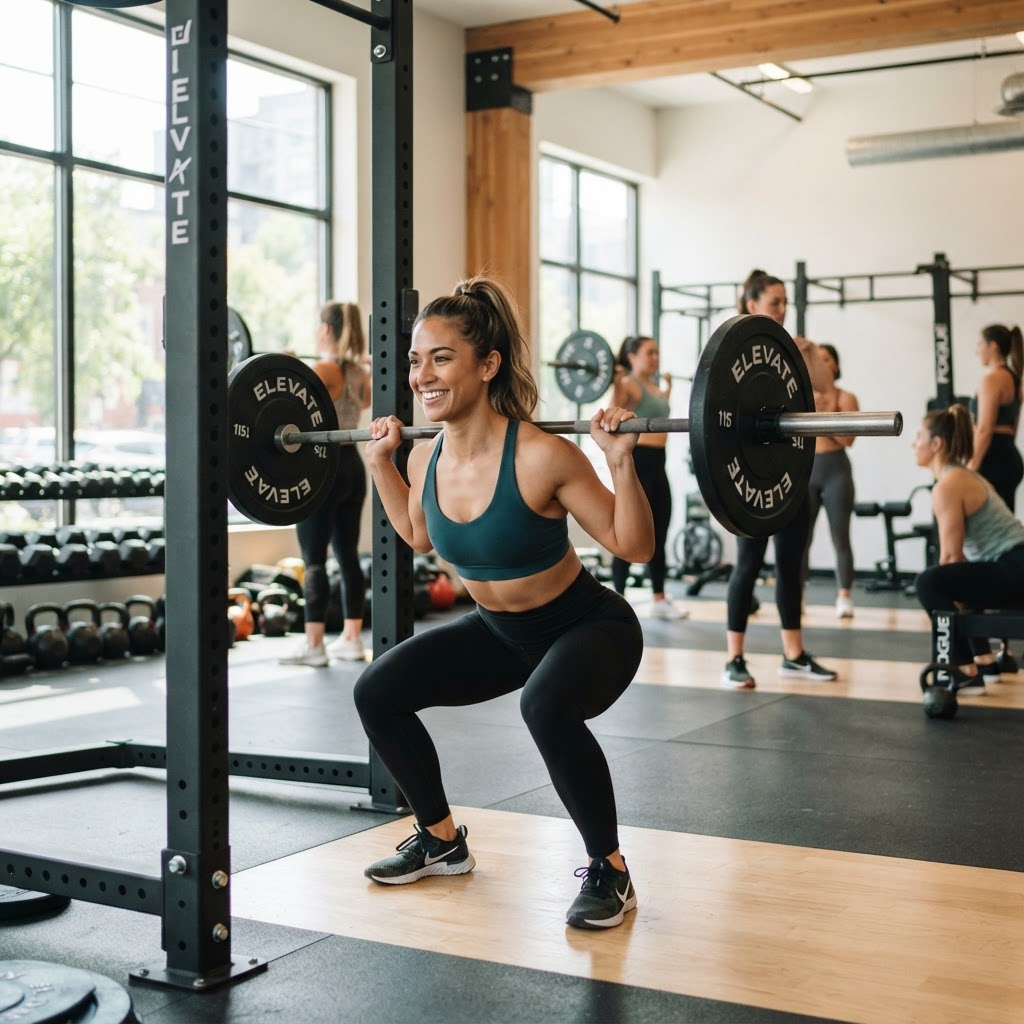
The Hidden Strength of Your Skeleton
When we talk about gym training at Clarence Park Health Suite, the conversation often drifts toward muscle tone or fat loss. However, there is a silent, structural priority that deserves your attention: your bone mineral density (BMD). As we age, particularly for women, the natural decline in bone density can lead to osteopenia or osteoporosis. The good news? Your skeleton is a dynamic, living tissue that responds remarkably well to the right kind of mechanical stress.
Why Free Weights Outperform Machines
While gym machines are excellent for isolating specific muscles, recent research suggests they might not be the most effective tool for bone health. A systematic review and meta-analysis published in Osteoporosis International found that free-weight training consistently produced higher effect sizes for improving bone density at the lumbar spine, femoral neck, and total hip compared to training on fixed-path resistance machines [9].
Why the difference? When you use free weights—such as dumbbells, kettlebells, or barbells—your body must engage in "stabilizer recruitment." You aren't just moving a weight; you are balancing it. This requirement for coordination and stabilization creates a more complex, multi-directional load on your skeletal system, which signals your bones to remodel and strengthen more effectively than the guided, linear path of a machine [9].
The "High-Intensity" Threshold
If you want to see real changes in your bone density, intensity matters. A 2025 meta-analysis published in the Journal of Orthopaedic Surgery and Research highlighted that high-intensity training—defined as 70% or more of your one-repetition maximum (1RM)—is significantly more effective at improving bone density at the hip and femoral neck [1].
This doesn't mean you need to be a powerlifter. It means that your training should feel challenging. If you can easily perform 20 repetitions with perfect form, the stimulus is likely too low to trigger an osteogenic (bone-building) response. Working with a personal trainer can help you safely identify your 1RM and progress your loads so that you are consistently hitting that "sweet spot" of intensity without compromising your form.
The Frequency Formula
Consistency is the bedrock of any fitness journey, but for bone health, there is a specific frequency that appears optimal. The same research indicates that training at least three times per week is associated with significant improvements in bone mineral density across multiple skeletal sites [1].
At our gym, we encourage members to view their individual gym access as a scheduled appointment with their future self. Whether you are working through a personalized program on your own or utilizing 1-to-1 personal training to refine your technique, aiming for three sessions a week provides the necessary frequency to keep your bone turnover markers active and positive.
Practical Steps for Your Next Session
If you are ready to prioritize your bone health, here is how to apply this science to your routine:
- Prioritize Free Weights: Shift the focus of your session toward dumbbells, kettlebells, and barbells. These tools force your body to stabilize the load, providing the multi-directional stress your bones crave.
- Focus on Compound Movements: Exercises like squats, deadlifts, and overhead presses load the spine and hips—the areas most vulnerable to density loss—more effectively than isolation movements.
- Progressive Overload: Keep a training log. If you lifted 10kg for 8 reps last week, aim for 10kg for 9 reps or 12kg for 8 reps this week. That incremental increase is the signal your bones need to grow stronger.
- Mind the Duration: Research suggests that sessions lasting around 40 minutes are effective for stimulating bone density improvements [1]. You don't need to spend hours in the gym; you just need to make the time you spend there count.
Building a resilient skeleton is a long-term project, but it is one of the most valuable investments you can make in your health. By choosing free weights and committing to a consistent, high-intensity approach, you are doing more than just building muscle—you are building a foundation that will support you for decades to come.