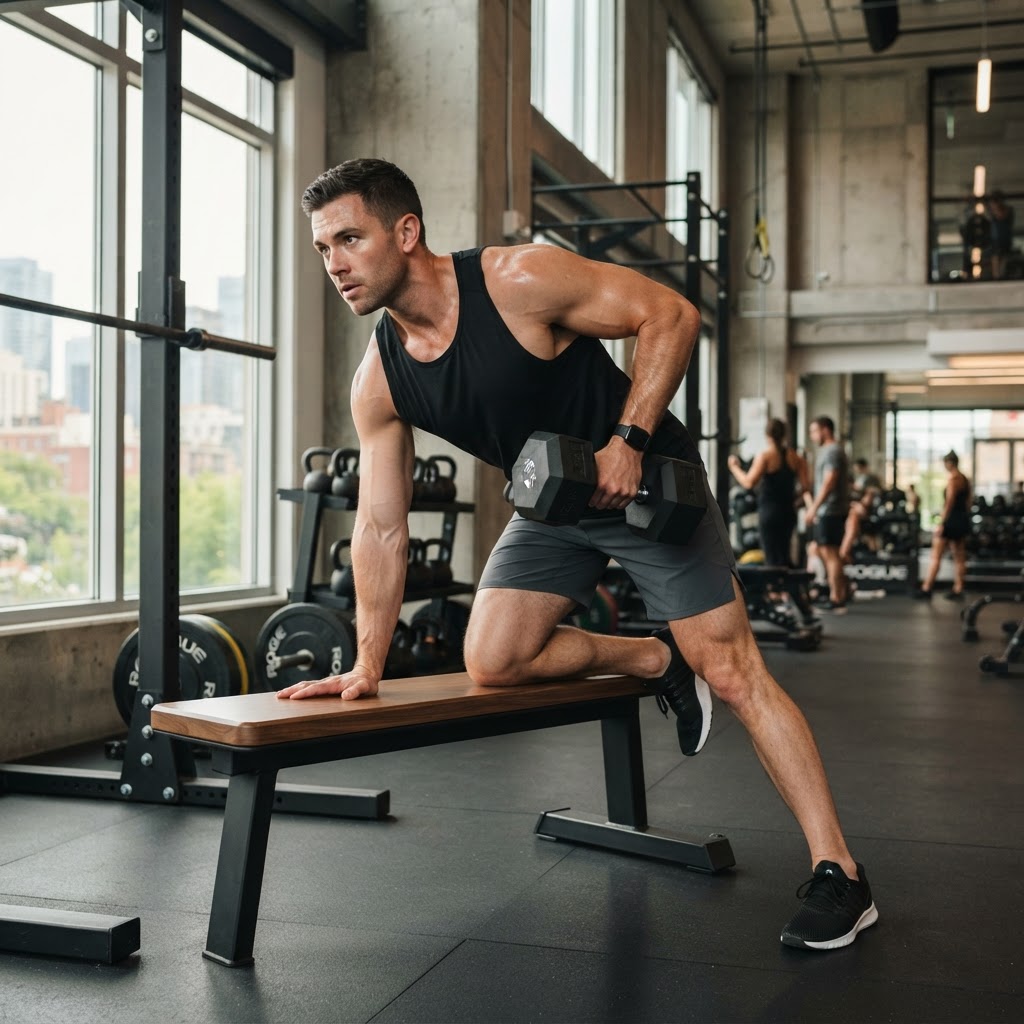
Rethinking Your Range of Motion
When you walk into Clarence Park Health Suite, you likely see the standard approach to lifting: move the weight from point A to point B, through the full range of motion (ROM). While full-range training is a cornerstone of building a solid foundation, recent research published in the European Journal of Applied Physiology (2026) suggests that we might be missing a trick by ignoring the 'top half' of our lifts [3].
The Science of the 'Top Half'
Researchers recently investigated how performing Partial Range of Motion (PROM) training—specifically focusing on the top half of a movement—affects the body’s hormonal environment compared to traditional Full Range of Motion (FROM) training [3].
Interestingly, while both methods are effective, the study found that initiating a session with PROM training led to a more sustained elevation in total testosterone levels immediately following the exercise [3]. While growth hormone levels rose after both styles, the specific hormonal profile triggered by focusing on that top-end tension offers a compelling reason to adjust how you structure your individual gym sessions [3].
Why This Matters for Your Training
At a friendly, local gym like ours, we focus on what actually works for your body. You don't need to be an elite athlete to benefit from these findings. If you are looking to shake up your routine or hit a plateau, incorporating a 'top-half' focus can provide a fresh stimulus.
It is important to note that this isn't about abandoning full-range movements entirely. Rather, it is about strategic application. By starting your set or your session with a focus on the top portion of a lift—where the muscle is often under different mechanical tension—you may be able to tap into a more favorable endocrine response [3].
Practical Application for Your Next Session
How can you use this at Clarence Park? Here are three simple ways to integrate this into your 1-to-1 personal training or solo gym sessions:
- The 'Top-Down' Warm-up: Before moving into your full-range sets, perform your first set of a compound movement (like a bench press or leg press) using only the top 50% of the range. This primes the muscles and may help optimize that hormonal response before you move into your heavier, full-range work.
- Focus on Tension: When performing these partial reps, don't just 'bounce' the weight. Control the movement. The goal is to maintain constant tension in the muscle fibers that are active during that top half of the lift.
- Pairing with Full Range: Use the partials as a 'primer' or a 'finisher.' If you are working with a personal trainer, ask them to help you identify the specific 'top-half' zone for your favorite exercises to ensure you are getting the most out of the technique.
A Note on Consistency
While these hormonal shifts are exciting, remember that the most important factor in your progress remains your consistency and the quality of your movement. Whether you are here to lose body fat, build muscle, or simply improve your general fitness, these small, evidence-based tweaks are designed to complement your hard work, not replace it.
If you are unsure how to safely incorporate partial range training into your current program, our team is always on hand to help you refine your technique. Sometimes, the smallest adjustment to your range of motion is exactly what you need to see the next level of results.